I started on this a week ago and a lot has happened: SlopCore, the AI-generated video genre, is ascendant! I love that AI has its own medium. And, while Q-Day is looming as a risk for cryptography, AI has suddenly come to the fore as well. Wonder what next week will bring?
Q-Day forecasts are based on known methods for breaking cryptography with a cryptographically relevant quantum computer. AI may discover new methods not thought of before. AI-Day is probably a real thing, and it is fast approaching. Does this mean Q-Day is no more? Far from it.
AI is already contributing to the accelerating development of quantum computers and quantum information science. We should fully expect that acceleration will continue and the combination of quantum computers driven by AI will lead to new discoveries, and possibly new ways of breaking existing cryptography as well as creating new cryptographic methods.
This video was generated with AI. I worked on it for about a week. My high-level process was:
I generated lyrics with OpenAI’s Astra model, based on my original Notes content. Then I used the final lyric sheet to generate multiple tracks and styles using Suno, selecting a final version for the video. From that, I worked with Astra to define the creative brief and treatment. I sourced a variety of references from generative-video creators including:
I fed all that into Claude and generated a high-level plan and many rough drafts of video for each section of the song. I estimate that I kept about 50% of the original brief during that step. Once I had all the sections of video I started production on the lyrics text including typography, animation, and effects. Following that I added in the HUD, color grading, video effects, and final delivery. All of this was done working with Claude. I estimate that Claude did 98% of the coding, and I did about 75% of the creative direction.
There was a lot of back-and-forth with Claude on:
Camera authoring
Editing
Lighting
Style and positioning of elements
Audio-reactive design
Typography and lyrics
Motif and decorations
Color grading
Post-processing and video effects
It’s impressive to see how quickly this AI-native media landscape is emerging.
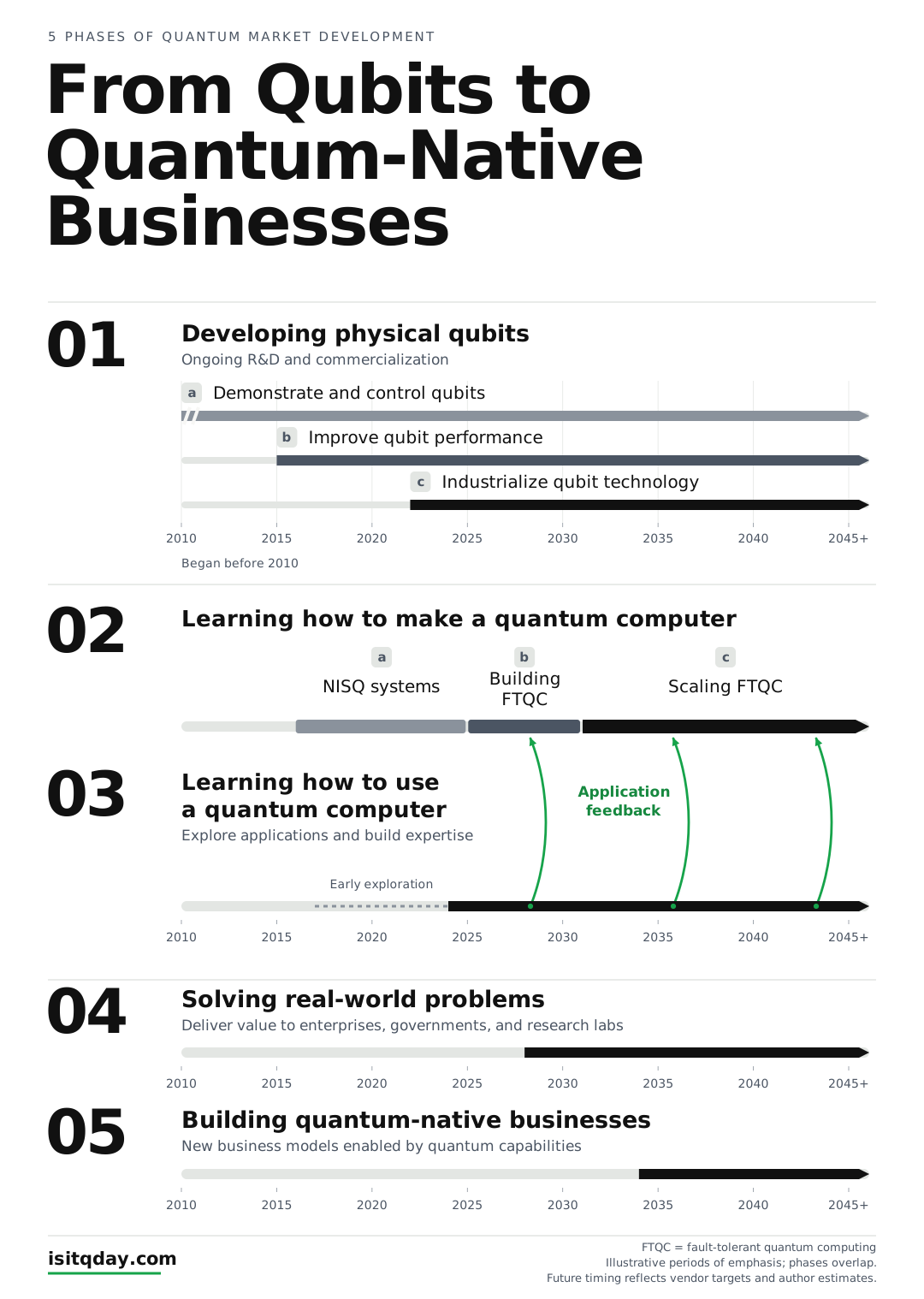
Once researchers could control individual qubits and perform entangling operations between them, the challenge expanded from making qubits to building a quantum computer. That requires a complex set of subsystems for qubit control and readout, calibration, quantum error correction with real-time classical decoding, quantum memory, and connections that move quantum information between QPUs. For more than a decade, all quantum computer development has been for the sake of learning how to make a quantum computer. Yes, it is true that several providers have made their systems available in the cloud or have sold systems to governments and research institutions, but the utilization of these systems by customers is in the spirit of acquiring market or end-user feedback in order to improve upon the next generation. Commercialization is a forcing function for moving out of labs and into the real world. The FTQC era will have several sub-phases, from building the first generations of FTQC to scaling them up. Each brings new R&D and commercialization challenges.
03. Learning how to use a quantum computer
While many in the industry will state that FTQC is an engineering challenge, phase 3, “Learning how to use a quantum computer,” is critical to enabling customers and developing the workforce. It is also critical to have tightly coupled feedback loops between users of FTQC and makers of FTQC. Real-world use of these systems will contribute meaningfully to the design and engineering of future generations of FTQC.
04. Solving real-world problems
When users are familiar with the concepts embedded in algorithms and understand the capabilities of these new computers, they can then apply their know-how to solve real-world problems found in their businesses. While quantum computing has been out of the labs for several years, it is my belief that time spent working with FTQC is a critical phase. Everyone who has, for example, run QAOA on a 32-qubit system or simulator knows that it is a useful learning environment, but it fails to beat classical benchmarks. Learning combined with FTQC leads to solving real-world problems. One requires the other, and businesses that invest in workforce development earlier will benefit sooner. I forecast that this begins as early as late 2027, and most likely in 2028.
05. Building quantum-native businesses
If you have read my Three Phases of the Quantum Computing Market, you will know that I see one of the major evolutions in the market as the move from existing businesses using quantum in their operations to quantum-native businesses built around this new computing paradigm. These are not providers of quantum technologies; they are builders who use quantum’s unique capabilities to create new businesses. This might signal the beginning of the quantum revolution, much as the beginning of the mobile revolution occurred with widespread availability of broadband mobile networks and significant market penetration of mobile phones. I forecast that this part of the market emerges around 2033–34 based on vendor roadmaps and corporate customers having had 5–7 years working with quantum computers and technologies.
The first useful FTQC systems will give existing businesses new tools. The larger market shift comes after people have spent years learning what those tools can do, then build companies around capabilities that did not exist before. That is the transition from solving problems with quantum computers to building quantum-native businesses—and the transition I expect to begin around 2033–34.
The analysis and forecasts that I have provided herein are based on proprietary information I have developed as well as publicly available vendor roadmaps.
Over the last sixteen months there have been five different publications from companies and research groups on cracking common cryptography protocols with a quantum computer. The main story is that the number of physical qubits required is decreasing from millions to sub million to tens of thousands. These are dramatic improvements across superconducting, neutral atom, and trapped ion modalities.
The typical metrics people have been looking at is the number of physical qubits and required runtime. These are published in the papers, and the dramatic decrease in physical qubits as well as the various runtime metrics provide the appearance of improving feasibility. But, there is one missing metric - Cost of Solution.
All papers are theoretical estimates and none of these machines actually exist (yet!). Reaching a verified or conclusive opinion is not possible. Regardless, I thought it would be interesting to construct a cost estimate for each approach as another way to gauge feasibility.
A cost estimate comes with its own theoretical quality. There is no quantum hardware company actually selling machines at this scale. I was able to do some research and come up with cost estimates or ranges of costs. Notably, IonQ’s analyst day deck puts the bill-of-materials cost of their 2,000,000 physical qubit trapped ion system due in 2030 at under $30M, against over $1B for a superconducting system of the same size.[1] BOM cost is not sale price, nor does it include implementation, operation, and maintenance. But it is a good anchor to use for their claim of ~19,400 physical qubits to crack secp256k1. Other vendors have provided various cost estimates for smaller scale systems. And, there is some data available that provides a portrait of costs for cooling the superconducting qubits.
Trapped ion systems from IonQ are by far the lowest cost of solution, at a range of $20M – $50M. Neutral atom systems from Oratomic come in at a range of $40M – $150M. Superconducting is by far the most expensive, with a range of $500M – $10B. Of course, time to solution is another factor.
Superconducting has a fast clock speed and theoretically could deliver results within minutes. While trapped ions and neutral atoms would deliver results within weeks or months.
IBM is making strides in its dilution refrigeration architecture for superconducting systems. Trapped ions and neutral atoms may be able to throw more physical qubits at the problem at a relatively low cost. And, new methods or techniques will emerge in the coming years. For now, I would consider this information directional, not verified or conclusive.
IonQ, “2025 Analyst Day Presentation”, September 12, 2025, slide 8: “<$30M BOM Cost” for a 2 million physical qubit system against “>$1B BOM Cost” for superconducting. The slide’s own source line reads “IonQ BOM cost estimates by Kearney; Superconducting data taken from publicly available information using reasonable extrapolation assumptions” — so the superconducting side is an extrapolation, not a vendor figure.
Madelyn Cain et al., Oratomic and Caltech, “Shor’s algorithm is possible with as few as 10,000 reconfigurable atomic qubits”, March 2026. For ECC-256: ~10,000 qubits in the space-efficient architecture and 11,961 in the balanced one, both at roughly 264 days; ~26,000 in the time-efficient architecture at roughly 10 days. All assume a 1 ms stabilizer measurement cycle.
EuroHPC JU, “Inauguration of SOL, a New Quantum Computer Together with LISA”, June 11, 2026: “SOL is co-funded with a total acquisition cost of EUR 13 million.” That buys a Pasqal neutral atom machine with at least 140 qubits in analogue mode — a floor for what neutral atom hardware costs, not a comparable fault-tolerant system.
Oratomic, $300M Series A, July 2026, co-led by ARCH Venture Partners, Spark Capital, and Khosla Ventures.
IonQ, “IonQ Announces First Quarter Financial Results”, May 7, 2025: “Announced $22 Million Deal with EPB, Including the Sale of a New Forte Enterprise.” The $22M covers the whole deal, including networking and joint algorithm work, so it is an upper bound on the system price rather than a list price.
IonQ, “IonQ Launches Superion Product Line”, September 8, 2026. The shift from laser-based to semiconductor-based control is expected to “reduce cost-per-qubit by more than 300x across the roadmap.”
On September 8, 2026, IonQ published their end-to-end architecture for breaking secp256k1. While we have estimated that ECC-256 would be cracked in 2028, this is the first fully compiled, end-to-end architecture and blueprint from a quantum computing company to provide a pathway to do so. Their approach would require just under 20,000 physical qubits and ~1,450 logical qubits, use Shor’s Algorithm, and require nearly 26 days of wall clock time.
secp256k1 is an elliptic curve cryptographic method primarily used in blockchain and cryptocurrency services. Notably, Bitcoin and Ethereum use it in signing or authorizing transactions at the wallet level. It is not used in mining operations. It is not as common in internet or web cryptography. You can read more about it on Ledger’s website.
While this is a new development, this does not change our estimates of when Q-Day arrives. It substantiates the existing June 10, 2028 date we have published.
If you have read our other notes you will have noticed that we believe acceleration is a key trait in quantum computing. Generally, first 2035, then 2030 were viewed as likely years when cryptographic methods would be cracked. We chose 2028 because we strongly believe that acceleration is more likely than not with this frontier technology. While IonQ’s paper is theoretical – it hasn’t been run on an actual computer and actually cracked secp256k1 – we believe that their approach will play out. Of course, keep in mind that more acceleration is possible and this date could arrive earlier.
Pasqal (PSQL) began trading on NASDAQ August 28, 2026, and is now part of QTI.
Pasqal is a French neutral atom quantum computing company.
The company was founded in 2019, after being spun out of the French Institut d’Optique. Nobel Prize winner Alain Aspect is a founder, board member, and key scientific member of the company. They develop quantum computers, software, and offer cloud services. Deployments include the CEA in France, CINECA in Italy, Aramco in Saudi Arabia, and DistriQ in Canada. Additional customers include Sumitomo, Thales, KAIST, and Capgemini.
Pasqal’s roadmap is conservative, showing 2 Logical Qubits in 2026 with 98% fidelity and 200 Logical Qubits in 2029 with 99.999% fidelity. You can read more about it on their website.
Pasqal is a strong addition to sovereign compute infrastructure in Europe and France. New funding will be useful for growing the team, accelerating product, and developing partnerships and customers worldwide.
We humans have many cognitive biases that impact our ability to make accurate predictions. One of these is the Exponential Growth Bias (EGB).[1] We tend to linearize nonlinear processes and underestimate the compounding features of exponential functions. When new technologies come to market, for example, we may have an understanding of how the product works and performs, but we often fail to accurately predict future performance and cost. It’s as if we take its current state and apply a linear function to its ongoing improvement. But, we fail to consider how change is a function of improvements across a set of components and manufacturing processes. And, how economies of scale can translate into dramatic improvements in performance and price. Exponential change is everywhere in nature. One only needs to watch a seed turn into a tree to witness exponential changes in scale. With a little effort and patience one can see it unfold in industry.
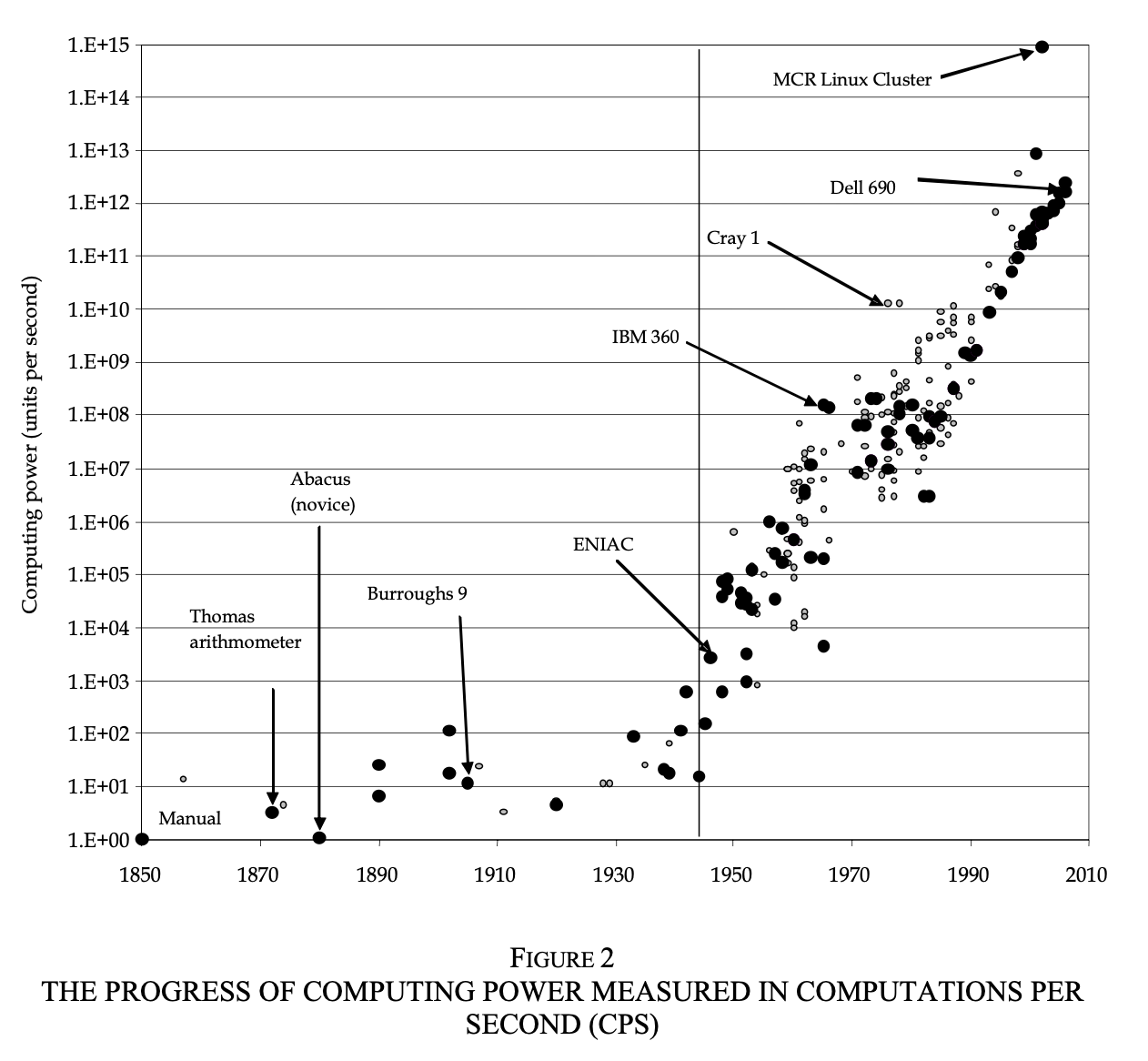
The semiconductor industry has been active for nearly 75 years. Computing has been around much longer, however. If we look at this chart from William Nordhaus, we see that he measures compute performance from the mid-19th century to the early 2000s. Over the period we see a one-quadrillion-fold performance improvement.[2] These exponential leaps in performance and efficiency exist in other industries too.
Source: Nordhaus (2007), Figure 2.
Lightbulb manufacturing and design, for example, was done by hand in the 1880s, producing about 165 lightbulbs per day. By the 1980s, the automated process achieved a 17,455-fold improvement, producing 2.88 million bulbs per day. Light would go from being a luxury to a common feature of society.[3]
Penicillin production from 1945 to 1980 increased 2,400-fold, with prices decreasing by a factor of 1,000. The impact during World War II and in the subsequent decades was significant in terms of lives improved and saved.[4]
The first human genome to be sequenced was an ambitious scientific and technological project. It started in 1990, took thirteen years, and cost approximately $2.7B for a single human genome. By 2007, the cost was in the millions of dollars per genome and took weeks. By 2014, the cost was $1,000 and could be done in a day. Today, the cost is in the hundreds of dollars and takes hours. The efficiency gain from $2.7B to $400 is 6,750,000-fold. A giant improvement. Going from thirteen years to four hours, we see a gain of 28,470x. While Moore’s Law drove down the cost of compute, most of the gains were achieved through processing improvements and chemistry. I think it’s important to keep in mind here that sequencing was done manually, but was limited to hundreds of base pairs. If scientists had attempted to sequence the entire genome manually it would have taken ~40,000 years of manual effort. The true efficiency gain, then, is 87,600,000-fold from manual mapping to today’s computer mapping.[5]
A technology or product that is exotic one decade becomes common and familiar in subsequent decades. It goes from extremely expensive to affordable, from being alien to being a necessity. Quantum computers are on a similar trend.
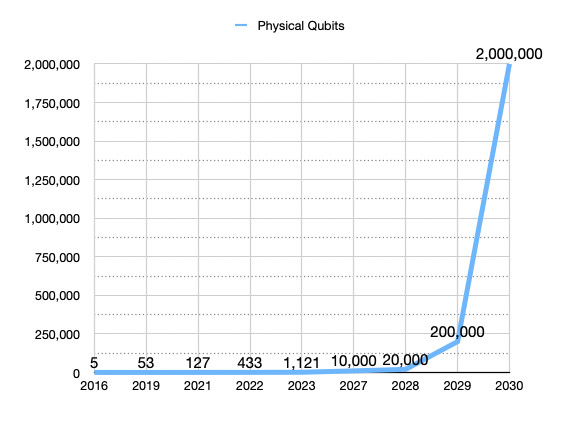
In 2016, IBM built one of the first quantum computers with 5 qubits. In 2019, Google built one with fifty-three qubits. By 2023, IBM’s machine reached 1,121 qubits. IonQ has the most aggressive roadmap — by 2030 they target 2,000,000 physical qubits. If their 2030 milestone is achieved that would be a 400,000-fold increase in 14 years.
Chart: isitqday.com
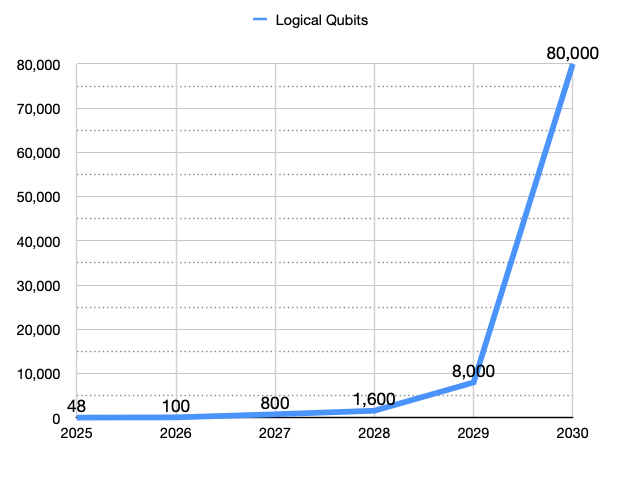
Now, these are machines with physical qubits and everyone knows that logical qubits are a better measure of performance (not a perfect one!). Logical qubit counts follow a similar curve. In 2025, Quantinuum offered a 48 logical qubit machine. In 2026, QuEra achieved 96 logical qubits from 448 physical atoms.[6] If we refer to IonQ’s roadmap we see 800 logical qubits in 2027, 1,600 in 2028, 8,000 in 2029, and 80,000 in 2030. That would be a 1,667-fold improvement in five years.
Chart: isitqday.com
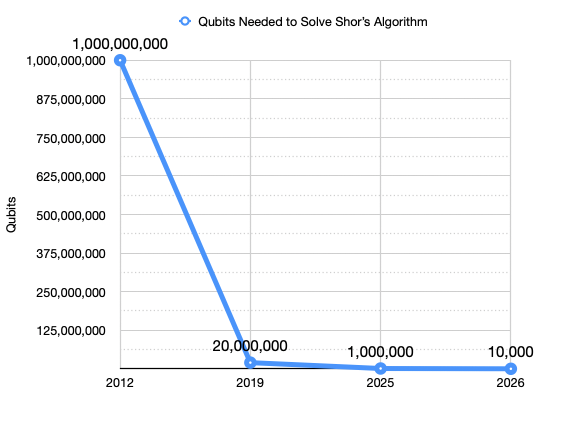
To get to this kind of performance the industry is relying on a mix of hardware and software improvements. Error correction is a key source of performance improvements. Looking at the resources required to run Shor’s algorithm from 2012 to today we see an incredible 100,000x reduction in the estimated number of qubits required, from 1 billion in 2012 to 10,000 in 2026.[7]
Chart: isitqday.com
Quantum computers were largely theoretical 15 years ago. They were then exotic machines available to only a few researchers. Today, there are hundreds of quantum computers available to researchers and to the general public via cloud computing providers. We are at the end of the NISQ era, beginning the Fault-Tolerant Quantum Computing (FTQC) era, a path toward optimal performance has been unlocked, and, as you can see, the efficiency gains achieved within a decade are impressive. If milestones on company roadmaps are achieved, the additional gains will be astounding.
Quantum computers are unlike classical computers, especially when it comes to the computational space they provide. Classical computers offer linear or single-exponential improvements across generations of processors. With quantum, each additional logical qubit doubles the available computational space. If the number of usable qubits also grows exponentially, across QPU generations, these two effects combine to produce a double-exponential expansion of compute space (sometimes referred to as Neven’s Law)[8]. Now, if you’re like me, you might read that sentence and draw a blank, and wonder: what does double-exponential mean?
A simple way to describe this is to define classical as having n values and quantum as having 2ⁿ values.
You can see how quantum’s computational space grows exponentially. Now, if we doubled the growth of qubits in each new generation (growing 2, 4, 8, 16, 32 and so on) we would see the double-exponential acceleration that people talk about. “Double” is doing some special work here. It assumes that each new generation of computer has twice as many logical qubits, which is not a law, but it is a trait we do see in the current era of hardware.
Even if we remove the double factor and just look at a quantum computer with 100 logical qubits (2¹⁰⁰) and compare that with IonQ’s 2030 milestone of 80,000 logical qubits (2⁸⁰⁰⁰⁰) we can see that the increase in computational space is… impossible to fathom. It is a number 24,000 digits long. Not just 24,000 times more.
The caveats here are worth mentioning. Algorithms do a lot of heavy lifting to produce meaningful results in this paradigm. There’s no free lunch; many qubits are needed to support the algorithm, such that actual logical qubits used for computation are less than 80,000. Not surprisingly, some believe that such an achievement is far-fetched.
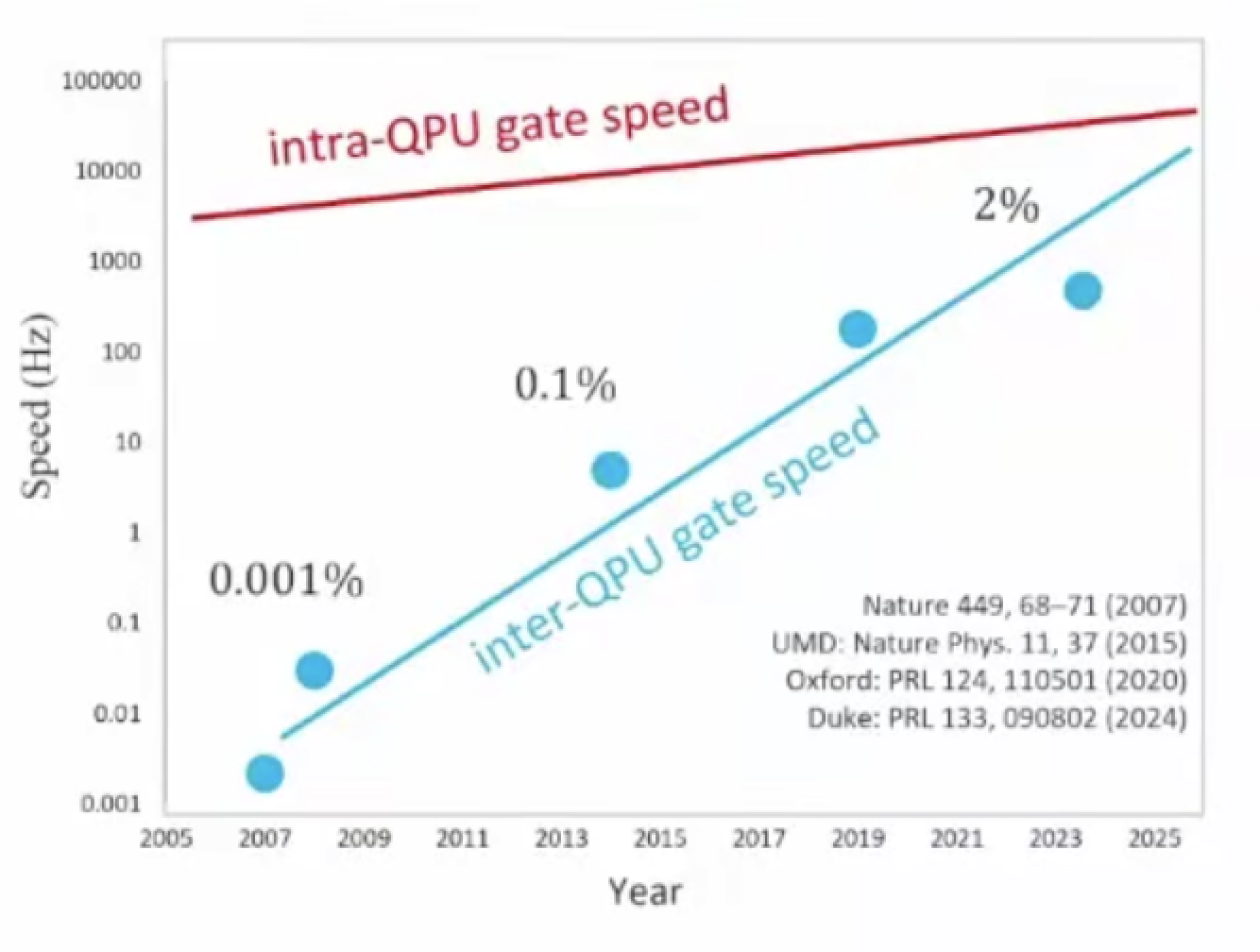
The most extreme skepticism comes from Palmer’s Law, which claims that a quantum computer can never entangle more than 1,000 qubits.[9] In recent years, problems that only quantum computers could solve have been cracked by novel classical methods, some using AI. Quantum advantage is achieved one year, only to be negated the next. Others have identified limitations in superconducting systems — expensive refrigeration and poor connectivity — making large-scale fault-tolerant quantum computing a remote possibility. Some have noted that scaling will require quantum memory (QRAM) and quantum networking which are still early in their development. Of course, it turns out that quantum networking is improving along similar curves.[10]
Source: Christopher Monroe, “Quantum Networks with Atomic Memories,” 35:24.
In the above chart, we see that in 2007 there was an inter-QPU gate speed of approximately 0.00196Hz. By 2024, researchers had achieved a speed of 250Hz. That is a 127,500-fold improvement. The blue trend line suggests that researchers will match or nearly match intra-QPU speeds in the next few years.
Quantum’s progress is driven, in part, by academic research. But, performance and efficiency gains in products are driven by industry and commerce. Chris Monroe is a co-founder and currently the Chief Scientist at IonQ. During the company’s early days he was the CEO. He tells a story about a time when he pushed back against making a system available on the cloud for commercial purposes. There was so much to solve, so many headaches to resolve, that he didn’t think it was possible. The board disagreed and essentially forced the team to do it. To Monroe’s surprise they delivered a commercial system (57:19). Often industry has the motivation and the drive to take scientific and technological discoveries and transform them into solutions for customers. Then, through running a loop of continuous improvement, the product becomes more and more efficient. As the business produces more and more, economies of scale emerge, making the product perform better at lower and lower prices.
Today, we sit at the end of the NISQ era. This era’s primary effort has been building quantum computers in order to learn how to make them scalable and fault-tolerant. In about five years’ time we will have the first scaled fault-tolerant quantum computers (FTQC) that will begin to transform industry. By the mid to late 2030s, these systems will be transforming and improving society, providing social and economic benefits to humanity. Looking back over the last century of progress we see how the lightbulb brought light to the world, penicillin reduced disease and increased our lifespan, and semiconductors transformed nearly every industry and human interaction. When looking forward to the next century of progress we’d be wise to accept exponential change as natural and see how quantum computers will carry human society forward.
Gates’ Law, attributed to Bill Gates, says, “We always overestimate the change that will occur in the next two years and underestimate the change that will occur in the next ten.”[11]
The semiconductor industry evolved over a period of thirty years from calculators to GPUs. The quantum industry will move much faster as it benefits from all of the semiconductor industry’s learnings and capabilities. Quantum is already benefitting from AI acceleration.[12] This new form of powerful compute will unlock scientific and technological discoveries and drive innovation throughout the next one hundred years.
Human Genome Project duration and cost from the NHGRI fact sheet; modern sequencing cost and turnaround from MIT Biology. The 40,000-year manual estimate assumes a few hundred base pairs per day across roughly 3.1 billion pairs.
The observation originates with Roy Amara — we overestimate a technology’s effect in the short run and underestimate it in the long run. Gates offered his own version in The Road Ahead (1995).
AI lab leaders seem hell-bent on scaring the public with their predictions of mass unemployment and the end of humanity. In May 2023, the CEOs of OpenAI, Anthropic, and Google DeepMind all signed a single sentence:
“Mitigating the risk of extinction from AI should be a global priority alongside other societal-scale risks such as pandemics and nuclear war.”
Prior to AI, the technology sector did what most businesses do when talking about their products: emphasize the benefits. I can’t say for sure why CEOs of AI companies are using fear to capture the imagination of the public. Perhaps it is to initiate a discussion about the risks of AI and to engage policymakers.
A cynical take would be that the labs are doing this as a way to grab attention, control the narrative, and create a sense of a burning platform with a clear path to safety. Some have accused Dario Amodei of having a savior complex — only Dario and Anthropic understand the technology and scope of the problem and therefore are best positioned to solve it. A Pentagon official put it less politely, calling him “a liar” with a “God complex.” A kind of “trust us — we created this monster, and we can tame it.” Others have accused AI labs of attempting to manipulate policy-makers in order to achieve regulatory capture, guaranteeing them a dominant position.
Whatever the case, it’s a pretty wild go-to-market strategy, one that seems to create more discomfort and antipathy towards the tech in the public’s mind.
When I look at the quantum computing industry I see a similar kind of marketing that emphasizes destruction — in this case, the breaking of cryptography.
I can easily convince myself that the technical challenge of building a quantum computer that can break cryptography is meaningful. Shor’s algorithm has been around a long time, and it has been viewed as a kind of prize to go after: a simple and clear proof that quantum computers actually work. From a research perspective it would be a huge success. The research domain is small, however, and the general public doesn’t really pay attention to it.
Now that quantum is moving out of the research world and into the commercial world, it is time for the industry to emphasize the constructive capabilities of quantum. Not that I think industry should halt the pursuit of cracking cryptography; there are legitimate customers (e.g., governments) that want this. Rather, the industry should be telling stories about the scientific and commercial breakthroughs that benefit humanity, that make us healthier and our lives better through chemistry, medicine, energy, and materials science.
It would be advantageous for the industry to establish some kind of Q-Prize that focuses on these domains rather than on cryptography.[1] At some point, Q-Day will come, and some might feel that their world is not much safer, inspiring a negative sentiment towards quantum. They may even want to have a moratorium on building quantum computers that are powerful enough to run Shor’s algorithm. If there is no good news about quantum, no clear benefit to refer to, then the story could devolve into skepticism and distrust of this new technology.
In an ideal world, the industry’s go-to-market plan would drive towards achieving beneficial milestones and make much of them before announcing a Q-Day breakthrough. And once those benefits are known, the arrival of Q-Day would be viewed with less fear and uncertainty.
I do see some of this appearing in recent communications from IonQ. Testifying before the Congressional Joint Economic Committee in November 2025, CEO Niccolo de Masi led with materials science, drug discovery, and energy, and made a point of the hardware itself:
“Trapped-ion systems run at room temperature. They don’t need giant refrigerators or exotic facilities, so they use far less power, fit in standard data centers, and plug directly into modern AI workflows.”
This is progress. But the industry could do more to establish clear milestones around achievements that make our lives better.
I am heading out on vacation for a few weeks and will be taking a break from writing Notes. I plan on reading “A History of France,” as well as finishing up the Brian Potter book “The Origins of Efficiency.”
A few years ago I read “To the Digital Age,” which provides an amazing account of the research and development of the transistor. The author covers the entire history from Bell Labs transistors to the early 1970s microchips. Lots of primary research included. It seems that many of these labs have deep and rich archives.
If you’re interested in technology and want to see a foundational technology emerge from the labs “To The Digital Age” is a great read.
I envision that the quantum computing market will evolve over three broad phases.
If you have been a student of technology diffusion and market development, these phases won’t be a surprise to you. A key trait to monitor is enablement: how accessible quantum computers are to customers. Enablement emerges from market dynamics which include availability, performance, and cost, to name a few.
Uncertainty about how and when quantum will mature has been mistaken for permission to wait for confirmation of its arrival. Waiting creates risks (i.e. cryptography) and potential delays as human capital needs lead times to learn and prepare. If you have read any of my other notes you have noticed that acceleration is a defining trait of quantum computing’s current development. One can wait, but take note that timelines are shifting while you look away.
One caveat: these are guides and not binary outcomes. Not all actors will follow this evolution precisely.
Phase 1: Copy-n-Paste
Companies adopting quantum computers will use them to solve their existing problems, and integrate them into their existing workflows. They copy their existing problems and paste them onto the new quantum capability. Paste is doing a lot of work, because reformulation will likely be required. This is a key learning phase for organizations going from 0 to 1 on the learning arc. But, the primary goal is to begin the integration of quantum into their business, their infrastructure, and to get on a path to realizing ROI from quantum investments.
During this phase quantum computers are limited in supply and are relatively expensive. Quantum is accessible, but the end-users are few. Performance in a few problems is better than the classical alternatives, but there are still many quantum computing challenges to solve before quantum solutions are applied broadly. Management probably says something like, “Quantum improves our business, but it doesn’t fundamentally change it.”" “What will you do with Quantum?” is the marketing call from quantum tech companies to their prospective customers.
Phase 2: Innovation
Quantum computers move from solving known problems to delivering innovations. By way of example, innovations in Social Networking emerged after years of use and experimentation with the internet, and then mobile technologies. These innovations also emerged at a point in time when the cost of operating internet services decreased dramatically, and there was widespread enablement of both infrastructure and end-user capabilities (e.g. terrestrial broadband, LINUX servers, PCs, mobile devices, and wireless broadband).
Quantum enters this phase when enablement is broadening, costs are going down, performance is going up, and capabilities are expanding. Relatively low-cost datacenter-ready rack-mounted quantum computers emerge as an enabling substrate. The phase 1 bottlenecks of cost and performance are largely waning, opening up the market to low-cost experimentation. Entrepreneurs and business unit leaders can follow a hunch, attack a problem, and cost is not their primary concern. They can build quantum-native products and scaling becomes economically feasible.
Venture capital is heading towards a full-tilt allocation into quantum technologies and quantum enabled businesses. Materials science and chemistry begin to achieve new discoveries and improvements in the basic inputs of our economy. Quantum is disruptive to incumbents who are not able to adapt and change.
Management in this phase says Quantum is fundamentally changing their businesses. So much so that they are able to deliver new product lines, and are considering forming new business units, joint ventures, and are making meaningful corporate venture investment.
Phase 3: New Industries
In this last phase we can look back and see that quantum has moved from insights, to innovations, to new products, to new companies. Value chains are now reorganizing around new capabilities and new constituents. The aggregate of efforts from phase 1 and 2 is now producing quantum-native companies and new industries.
There will be several industry-defining companies. I won’t try to predict what those will be, but we can look at an example from prior eras: Uber. Uber is often referenced as a company that helped form the on-demand industry. Without the widespread enablement of mobile and location services, and the various attempts and failures in this category, this would not have occurred.
During this phase, quantum computers are widely available via cloud-services. There are likely a few quantum-native clouds, but the bulk of quantum computation occurs in AWS, Azure and GCP. Free tiers of service provide entrepreneurs with zero-risk access to quantum compute so they can experiment and validate ideas. (There is, of course, a class of quantum supercomputers that exists in corporate and government research labs, but most users rely on the cloud.)
While many agree that quantum computing will generate important discoveries and innovations in materials science and chemistry, it should not be ignored that nearly all economic activity is downstream of activity in these two domains. And, finally (the slow-pitch prediction that is easiest to predict): the biggest and most important innovations in the 21st century will be catalyzed by quantum computers.
Closing
Foundational technologies have century-long lifespans, and generate many innovations. They give birth to technology platforms, such as the PC, smartphones, and networks. Generally, these new technology platforms have a 20 to 25 year growth cycle and then a new platform and a new growth cycle emerges, creating new opportunities for innovation. During these cycles incredible efficiencies are achieved. The transformation of genome sequencing from a scientific research project to a commercial offering is one such example.[1]
For example, today we are about 20 years into the smartphone (if Blackberry is the base year). The PC growth cycle ran for about twenty years before smartphones became the dominant source of growth for the value chain. If Quantum is a foundational technology, we are at the beginning of at least 100 years of productive innovation generation, giving birth to many new technology platforms with their own 20-25 year growth cycles. We are at the beginning of a century-long cycle of scientific discovery and technological innovation, with massive societal benefits.
In other notes I have stated that there is commercial Q-Day, a sibling of the cryptographic Q-Day, that could appear as early as 2027. Waiting for that to occur may seem wise, less risky. But, waiting disadvantages organizations that need to migrate their security systems, acquire and train talent, and develop the institutional know-how needed to participate.
The first human reference genome required roughly six to eight years of active sequencing and an estimated $500 million to $1 billion to produce; the broader Human Genome Project ran for 13 years and cost approximately $2.7 billion. Today, an individual human genome can be sequenced in about a day for roughly $1,000. This represents a one-million fold gain in efficiency!
A core metric of manufacturing success is performance improvement achieved vs prior processes/methods. A core metric of product success is improvement in performance capability.
Over and over we see industries dramatically improve their performance metrics. 100x and 1,000x improvements sound amazing. And they are everywhere. 10,000x and 100,000x improvements sound exotic. 10,000,000x seems insane. These also appear in products we use every day[1]. Classical computers have already delivered >1,000,000,000,000x improvements in performance when compared with early computers[2].
I propose 1,000,000,000x improvement is a reasonable goal. And I am beginning to think that quantum computers could achieve that in the 2030s. And, I posit, industries which adopt quantum computing will also benefit and achieve similarly outsized performance improvements in their methods, processes, and products.
During the Agrarian era value was captured by making use of the surplus provided by nature, a free gift of nature. If you lived near a river, you could pump water from the river to the land you owned that nourished the crops. Every day the sun provided free energy. It was a kind of manna from heaven.
In the digital era, there’s a different kind of manna from heaven: the ability to make exact copies of bits and bytes at zero marginal cost. A free gift of cyber, if you will. Copying data is something we do every day, all day long. The entire cybernetic system of operating systems, applications, sensors, files, networks, and cloud computing exists because data is easily copyable, portable. (This is not going to be a rant about memory, I promise you!) In quantum computing, the situation is markedly different. Which makes me grateful for the incredible bounty that copying has enabled.
Quantum mechanics says that quantum information cannot be cloned. No copying. Qubits can be coaxed into interesting quantum states which we then want to measure. When a qubit is read, its quantumness leaves us and the waveform collapses. Copying would require reading the information and copying it into a new qubit. Copying would violate the no-cloning theorem of quantum mechanics.
This would be the part where you might want to trip out on the [observer effect](https://en.wikipedia.org/wiki/Observer_effect_(physics). I’ve grown accustomed to thinking of superposition and entanglement as accepted characteristics of qubits. But, the observer effect is hard to accept and simply makes no sense. Spooky action at a distance is one thing, but that observation causes quantum effects is just strange (and exciting!).
“…encrypted cloning, has shown that, in theory, it is possible to deterministically create any number of perfect clones of an arbitrary state if, during the cloning process, the clones are encrypted with a quantum single-use decryption key: among the encrypted clones, one can freely choose any one to decrypt and thereby recovers the original state with fidelity up to 1.”
And,
“The decryption process consumes the decryption key, thereby rendering all remaining encrypted clones indecipherable, which ensures consistency with the no-cloning theorem.”
In lay person’s terms, for I am one, concealing the quantumness with encryption means it can’t be observed, and therefore it can be cloned. And, there’s theoretically no limit to how many times it can be cloned, but there is a practical limit. Once a clone is decrypted, all other clones also are rendered useless.
There’s a lot to unpack here. But, two things jump out at me:
It seems that scientists are learning how to find a way through, or way to work with, the observer effect and the no-cloning theorem. From an academic perspective this is fascinating to see unfold in this research.
There’s a real use case in having qubits that become indecipherable when a clone has been read. It can serve as a symbol defining when data has been accessed or not. If you’re a user receiving data and a cloned qubit is readable, that is a good sign. If a cloned qubit is indecipherable, someone has already attempted to read the data, and that could be a bad sign.
This isn’t at the scale of digital cloning capability we have with classical systems. But, it’s an interesting step towards that.[1]
In years to come, I suspect we will see more improvements to this technique and new use cases. Whether or not the free gift of quantum lies in getting around the no-cloning theorem remains to be seen. For now, that free gift is the exponential computational space that quantum information systems give us.[2]
There is also a related, active world of research and commercialization for quantum memory. Quantum states are transferred from one qubit to another, and a primary use case is network repeaters. During the transfer process the original qubit is destroyed, and during the read process the intermediary qubit (memory qubit) is destroyed. The no-cloning theorem holds throughout.
The workspace of n qubits is 2^n-dimensional, but a measurement returns at most n classical bits — you can’t read the whole space out (the Holevo bound).
Oratomic is a California-based quantum computing company that emerged from CalTech. John Preskill is listed as an advisor.
They are focused on the Neutral Atom modality. Some people think that Neutral Atoms will be one of the top 3 modalities, along with Superconducting and Trapped Ions. Some people think that Superconducting is just too expensive to ever be a viable modality. I’m not convinced that Superconducting is out of the running; they may find a way to reduce build costs over the next few years. Regardless, Oratomic is quite interesting.
First, they delivered a very compelling error correction story when they announced their formation earlier this year. Their initial 6100 physical qubit system portrayed a clear path to a 10,000 physical qubit system that can deliver fault-tolerant capabilities. Previously, it was thought that true fault-tolerant systems required 1,000,000 physical qubits. A 100x improvement means less complexity, and likely a much lower cost of solution.
Second, they are emerging at an interesting time. The market is orienting around several companies that have been building quantum for a decade or more. Oratomic is new, and sometimes new entrants have something innovative aand are not held back by their legacy. I think Oratomic has both of these. Oratomic is mostly unencumbered by having to convince the world that quantum computing is possible. Their starting point is far ahead of the incumbents, and they have a running start, rather than a crawl.
Third, John Preskill is a luminary in the field, one of the leading academics. His joining a commercial entity means he genuinely believes that Oratomic has the goods. I wouldn’t weigh Oratomic solely on this, but his presence means, at least, that Oratomic has a shot at being a key player in the Neutral Atom space, and perhaps in Quantum Computing generally.
Oratomic says that they expect to deliver a fault-tolerant machine by the end of this decade. I suspect that they will achieve that sooner.
The quantum era is far from over: expect new entrants, new techniques, new breakthroughs.
Update: Scott Aaronson, a leading quantum information researcher and academic, is also listed as an investor. Having Preskill and Aaronson involved is meaningful.
IQM (IQMX) began trading on NASDAQ July 2, 2026, and is now part of QTI.
IQM is a Finnish superconducting quantum computing company.
Some key facts:
Founded 2018
Have sold 23 systems
$36M in 2025 revenues, $100M in bookings
IQM is generally considered to be a European leader in superconducting quantum computing. Selling twenty-three system is a strong result, and demonstrates its ability to manufacture, sell, and support quantum computers. Recently, they sold a system to Oak Ridge National Laboratory in Tennessee.
Revenues are on par with Quantinuum, Rigetti, Infleqtion, and D-Wave.
Fault-Tolerant Roadmap:
2027 - 36 Logical Qubits
2028 - 180 Logical Qubits
2030 - 720 Logical Qubits
2032 - 7200 Logical Qubits
While it is not the most impressive roadmap, I, as you might expect if you have been reading my Notes, will assume some acceleration. Perhaps IQM achieves its 2030 target in 2029.
“Advances in quantum research and development have shifted the risk horizon. We believe cryptographically relevant quantum computers could arrive sooner than previously expected—and the work required to prepare is significant so organizations need to start now.”
As I have stated before, acceleration is a feature of Quantum Computing. AI is driving acceleration, especially in error correction. Engineering and commercialization is driving acceleration in the availability of working quantum computers. Microsoft is taking note.
While I am putting Q-Day in 2028, Microsoft is shifting their timeline to be ready by 2029, which aligns with most major tech firms.
“In response to these shifts, we are accelerating the Microsoft Quantum Safe Program (QSP) timeline with the goal of transitioning critical products and services to PQC by 2029.”
Consider this another reminder to update your systems to support PQC.
QuEra published a new roadmap on June 25, 2026. You can read about it on their site.
Key takeaway — QuEra is accelerating.
Acceleration is an important trait of the quantum sector. It is driven by the forces of commercialization, engineering, AI, and competition. These factors have allowed companies to build NISQ era computers (ie building a quantum computer in order to learn how to build a quantum computer), and position them for the fault tolerant era on the horizon.
QuEra has a major backer in Google, who has funded its venture rounds. Google has also decided to invest in neutral atoms, in addition to superconducting, via a partnership with University of Colorado at Boulder, NIST, and QuEra.
Their roadmap features two important milestones. First, in 2028 they intend to deliver a 256 logical qubit system with 99.9999% logical error rate. Second, in 2029, they intend to deliver a 1000+ logical qubit system with 99.999999% logical error rate. These are both big numbers.
There are some experts who believe that useful quantum computers are 10 years away. 1000+ logical qubits is very compelling, and is enough to achieve Commercial Q-Day, but not quite enough to achieve Cryptographic Q-Day. While 2029 is about 3 years away, keep in mind that additional acceleration is likely to occur.
As a side note, the US government’s Genesis mission to build a scientifically meaningful fault tolerant quantum computer by 2028 with 100s of logical qubits is being funded. 2028 is only two years away. My sense is that the government and industry have a high degree of confidence that this date can be achieved.
Rumors about upcoming Executive Orders (EO) from Trump administration were published today.
The article referred to two EOs: One for furthering government investment in the industry including funding to develop a quantum computer for government research. The second EO is said to be focused on enhancing efforts to migrate to post-quantum cryptography (PQC).
There have been rumors about EOs for quantum in the past. Usually the EO does not occur on the schedule rumors put forth, so take these rumors with a grain of salt.
For the PQC angle, the assumption is that this EO would move up the US’ civilian migration deadline from 2035 to 2029 or 2030. This new date aligns with industry and academic experts. It is also much closer to my 2028 deadline. I don’t think there is new information that timelines are accelerating above the current rate. More likely, the government is formally establishing deadline.
As for the commercial aspects, we could see more investment and purchasing from government. Notably, IonQ was not part of the $2B investment the government made in nine quantum companies last month. IonQ has said that they are unable to issue shares during a merger event.
UPDATE: One EO sets PQC Migration to 2031 as the milestone. The other EO is a deeper scope around establshing a spec for a future quantum computer that government can buy. It also lays out new requirements for supply chain security. And, establishes intent to source quantum sensing products for the government.
AI generated content is everywhere these days. The Dead Internet Theory doesn’t seem like a conspiracy. I see it on Youtube, X, LinkedIn, Instagram, and so on. While AI does seem like a technology that potential to benefit society, generic AI content (aka Slop) seems like we are going backward as a society when we rely on regurgitated takes rather than authentic human expression.
I have been using AI assisted coding for about eighteen months. This site is developed and maintained with AI. This site is simple, and AI is good at getting the job eighty percent done. AI can’t do it all, it will hallucinate and make mistakes. Not long ago I discovered that the math to calculate the number of days until Q-Day was wrong, even though the correct formula was in the comments that AI left in the code. It wrote the comment, and then ignored it. Frustrating at times, for sure.
Using AI for developing websites is a really good idea. This site’s specification is basic, so the actual coding isn’t complex. Something that would take me a few days to get up and running can be done in a few hours. But, AI fails when it comes to designing.
IsitQday’s layout is familiar — nothing special or innovative. Familiarity is fitting here. But, AI generated websites all look a like. They have the same purplish or indigo tones. Subtle gradients, and tend to pick accent colors that glow against the primary colors. The typefaces are all the same too — Inter and Roboto dominate. I’ve made an effort to improve upon the AI’s design by reducing content that just adds noise and clutter, changing the color palette to focus on readability, and updating fonts for readability.
AI for research is also quite useful, but it’s not a full replacement for doing my own research. Exploring on my own is central to learning, and is key to the discovery process. The path of research is a linked set of information, showing connections, and relationships. Forming spatial connections between ideas, concepts, and publications helps me to understand and remember information. AI research is good, but taking shortcuts in learning produces gaps in knowledge. And, reliance on a research partner that is known to make things up is unwise.
In my own consumption of AI created content I have found that I quickly lose interest when looking at AI generated images. The similarity in style is off-putting. It comes across as a bit careless, lazy. And I feel the same way about AI used for writing. AI winning writing competitions leaves me cold.
I read to hear from others, to learn, to be transported to another world of someone else’s imagination. When AI writes it feels half-hearted, half-baked, half-ass. Reading AI authored content leads me to conclude that the human who prompted the AI didn’t care enough to even try to share what they think. Disappointing a reader with half-ass effort does not win them over.
While I am not sure my words will win you over, I do believe we all benefit when humans are doing the research, the thinking, and attempt to convey their insights in their own words.
Q-Day is a colloquialism to represent a point in time when quantum computers are capable of cracking encryption. I propose that there’s another kind of Q-Day, the day when quantum computers are capable enough to solve problems for businesses that classical systems cannot do on their own. I will call this Commercial Q-Day.
At a point in time we will learn about a quantum computer playing a key role in solving a business problem. “Key” here means without quantum, classical could not solve it in a reasonable amount of time, cost, or other practicality. This doesn’t mean that quantum solved the problem without any classical compute. For the foreseeable future, most quantum compute work will be hybrid, including CPUs, GPUs, and QPUs.
Now, some folks familiar with this space will point to examples of enterprises using quantum to solve a problem. They will point to this or that press release or paper where there is a claim of quantum advantage, or a demonstration of quantum being applied to a business problem. But, this is not the Commercial Q-Day that I am thinking of. The scope should not be a one off, for that looks like a marketing project done for a marketing team. The problem should be an ongoing problem where quantum is used regularly or frequently.
The key point is that the enterprise uses quantum not just once, but regularly or frequently for this problem. And, the business has moved from being quantum curious to being a paying user that relies on quantum to run their operations.
If we look at the current projection of quantum capabilities in vendor roadmaps we can see that powerful quantum computers arrive in 2028. If you have read any of my other Notes you will know that I see ongoing use of AI by quantum companies (eg error correction) and the force of commercialization causing acceleration in roadmaps. Which is why I believe that Commercial Q-Day will arrive sometime in late 2027. That’s not a day. So, let’s pick a day.
Previously, for Encryption Q-Day, I picked June 10th. A midpoint in the year. But, I think Commercial Q-Day happens closer to 2028 than 2026. Thus, I am identifying December 3, 2027 as Commercial Q-Day.
As of this writing, on June 12, 2026, there are 539 days until Commercial Q-Day.
Note: I am focused on gate-based systems and exclude D-Wave from this analysis, at least until they have a meaningful superconducting product offering.
We estimate that Q-Day will come on June 10, 2028. That is 2 years from today.
Several protocols are at risk. Most concerning is the legacy RSA-1024 standard that is used in many older systems for authentication.
We are anchoring our target to available Logical Qubits in vendor roadmaps. As of this writing, IonQ has the most aggressive roadmap with 1600 logical qubits in 2028 and 8000 in 2029. 1600 logical qubits is not enough to crack RSA-1024. You are probably asking, why is 2028 the year in which Q-Day falls? Because we firmly believe that the acceleration of capability will continue through the next 2 years.
Roadmap
LQ = Logical Qubits. PQ = Physical Qubits.
Vendor
Technology
2026
2027
2028
2029
2030
IonQ
Trapped Ion
100 PQ
800 LQ
1600 LQ
8000 LQ
80000 LQ
PsiQuantum
Photonic
—
—
100 LQ
1000 LQ
—
Quantinuum
Trapped Ion
50 LQ
100 LQ
100 LQ
“100s of LQ”
1000s of LQ
Infleqtion
Neutral Atoms
30 LQ
—
100 LQ
—
1000 LQ
Google
Superconducting
1 LQ
10 LQ
20 LQ
“Dozens of LQ”
100+ LQ
Xanadu
Photonic
—
—
—
500 LQ
500 LQ
IBM
Superconducting
120 PQ
—
—
200 LQ
—
Pasqal
Neutral Atoms
2 LQ
20 LQ
—
200 LQ
—
QuEra
Neutral Atoms
100 LQ
100 LQ
—
—
—
Rigetti
Superconducting
150 PQ
1000 PQ
—
—
—
D-Wave
Superconducting
—
—
—
—
10 LQ
Google
Neutral Atoms
—
—
—
—
—
Microsoft
Topological
—
—
—
—
—
Photonic
Photonic
—
—
—
—
—
Innovation in error correction over the last five or six years has led to acceleration. Such innovation is in part due to the availability of functional NISQ systems — researchers have working systems to test and learn from, systems that did not exist in any accessible quantity prior to 2020. Additionally, IonQ and Oratomic researchers have publicly stated that AI has been an accelerant for their work in error correction.
For a detailed overview of 2026 advances in quantum cryptography for blockchain visit Nic Carter’s substack.
We assume that this acceleration will continue due to advances in software and hardware. AI will continue to improve. Currently, about every six months a new frontier model is released that is more powerful than the prior. Engineering at quantum computing companies continues to find ways to pull in their roadmap dates. The NISQ era build-out is largely about “building a quantum computer in order to learn how to build a quantum computer.” Now that NISQ is ending, we expect that leading firms will find ways to optimize their hardware that improve its stability and reduce the time to market.
In addition to technical innovations, changes to business process can also produce timeline acceleration. IonQ has said that their acquisition of Skywater Technologies will accelerate their design process. Their 2029 roadmap target of 8000 logical qubits would be pulled into 2028, if the merger closes. So, not necessarily an engineering issue as much as reducing the time to wait for design cycles at a third party, by making them first party. Magic.
In many parts of our modern world, two years can seem like a long time. What we are trying to emphasize is that there’s jaggedness in time, and two years may end up being 12, 14, or 18 months, and not twenty-four months. This means more important protocols like RSA-2048 could be at risk in … two years and not three.
Fortunately, standards bodies have defined and developed post-quantum-cryptographic (PQC) solutions which can be invoked today. And, many leading firms are already making the necessary changes. If you’re not, now is the time to act! Objects in mirror are closer than they appear.
Almost exactly one year ago, I found a way to make quantum attacks on elliptic curve cryptosystems ten times cheaper. Specifically, I found a better way to perform elliptic curve point addition on a quantum computer. I wanted to publish these improved point addition circuits, to enable cryptographers to make informed decisions about when they’d need to transition away from quantum-vulnerable cryptosystems. I’ve done this several times over the past decade. However, this time, something new happened: I got pushback on publishing.
One of the challenges facing the industry is how to disclose vulnerabilities. Often some form of coordinated vulnerability disclosure is done where affected organizations are notified in secret about the vulnerability. But, a cryptographically relevant quantum computer (CRQC) that has the ability to crack foundational elements of the internet creates a kind of universal zero-day exploit that impacts many organizations and significant components and systems. It would seem irresponsible to not disclose this broadly.
On the other hand, the path leading up to Q-Day is filled with research, laying the steps to when a CRQC can crack encryption. Researchers revealing their technique means both good and bad actors have access to the recipe. No good-intentioned researcher wants to enable criminals or other bad actors.
In Gidney’s case, he chose to publish a Zero Knowledge Proof (ZKP). Essentially, this allowed Gidney et al. to share the validity of the proof but not the mechanics of the proof. But, this does not remove the interest or desires of other researchers.
Gidney:
Saying you have a solution, but that you won’t share it, is a great way to draw attention.
It’s also a bit like the first runner to run a sub-four-minute mile. Once it’s done, suddenly it is possible for many others. Or, more recently, a sub-two-hour marathon.
Most likely, government entities involved in surreptitious decryption will likely not reveal when they have a CRQC and its relevant techniques and can formulate successful attacks. However, in the commercial and academic spheres I assume (hope?) we will have vocal revealers warning the public (like Gidney). The obvious benefit to revealing is to mitigate the harms of broken encryption (your bank, your email, corporate secrets, infrastructure, etc). Another benefit of revealing is that it leads to more researchers working on the problems, which typically leads to better solutions and improvements, even if there is some near-term pain.
Of course, all of this can be avoided by pursuing PQC solutions today.
I recently added some details about authentication in the Threat Briefing section, “The Authentication Avalanche.” Previously, I included Harvest Now, Decrypt Later, and Cryptocurrency Security. Both of those are substantive — loss of secrecy and privacy from HNDL attacks, and billions of dollars of assets are at risk in crypto. But, the Authentication issue seems to be more concerning.
When we use the internet we often sign in to services. That’s how most of us commonly think of the scope of authentication and security. But, systems on public and private networks often communicate with each other without any human intervention. They do that securely by using credentials. Those credentials are based on cryptography that is susceptible to quantum attacks. And, there are billions of credentials suscpeptible to quantum attacks.
These are systems which run the internet, run manufacturing, run healthcare, and so on. The scale is truly daunting.
There are discussions about this, but how much is being done about it? Our research shows that Cisco is well aware of this and making necessary changes. But, we have not found other players in industry to be responding similarly. This lagging response is very concerning, and I hope that there’s more going on behind the scenes than appears in the public domain. Godspeed.
Quantinuum is set to IPO on Thursday June 4, 2026 under ticker QNT.
Quantinuum is the NISQ era leader with its 48 logical qubits and industry lead 99.92% fidelity. Additionally, QNT has the heritage of industry scale and engineering excellence of its parent, Honeywell.
Their revenue and projections:
Year
Revenue
2025
$30.9M
2026
declining
2028
$266M
2029
$856M
2030
$2.5B
Note: 2028–2030 are projections. I don’t have a 2027 figure.
The company expects an inflection to occur in 2029, when they deliver their APOLLO system. Their prospectus teases a new LUMOS system in ~2030 with 1M physical qubits (no published logical qubit number, but should be in the thousands).
While QNT’s roadmap is below what IONQ has published (80,000 logical qubits in 2030), QNT has proven their approach out in recent years and deserve some premium for accomplishments and heritage. QNT is claiming the mantle of the first quantum technology industry IPO (not a SPAC). And, their float is quite small — about 10% of total will be made available for trading. They have a great story, a transformative technology, proven accomplishments, and great heritage. Expect fireworks at IPO.
Going forward, after IPO, one should expect that QNT will move based on story — milestone achievements/misses, breakthroughs/setbacks, and customer wins/losses.
As it relates to Q-Day, QNT will likely not deliver a machine that can crack RSA-1024 until APOLLO in 2029. RSA-2048 will likely not be cracked by QNT until LUMOS arrives sometime in 2030 or later.
All in all, the Quantinuum IPO represents a maturing of the quantum market with the introduction of a new pure-play that has solid history and heritage. The funds they receive will surely lead to M&A, and possibly the acceleration of its roadmap.