Alice & Bob is a quantum computer company based in Paris, France and was founded in February 2020. The company has raised €180 million. Investors include Bpifrance, European Innovation Council, as well as several private investors and NVentures, Nvidia’s venture arm. Their partners include Thales, CEA and Nvidia. GENCI, France’s national supercomputing agency, appears to be their only paying customer who purchased an 18-qubit system in June of 2026, to be released in 2027.
The company was founded by Théau Peronnin (CEO), Raphaël Lescanne (CTO). Lescanne’s academic research includes the first prototype of a cat qubit. Élie Gouzien is a researcher and co-author of their recent RSA paper described below.
Their goal is to build a computer using cat qubits. Cat qubits were conceived of with error correction in mind. Qubit errors come in two types: a bit flip or a phase flip. Cat qubits approach this problem by making bit flips rarer, and using resources to address phase flips. The company says that their approach “sharply cuts the number of physical qubits per logical qubit.” Of course, there are trade-offs: their approach increases phase flips. While this is working at a very low number of qubits, building a functional computer is still theoretical.
On October 29, 2026 the company posted on X.com stating:
 Alice & Bob@Alice__Bob
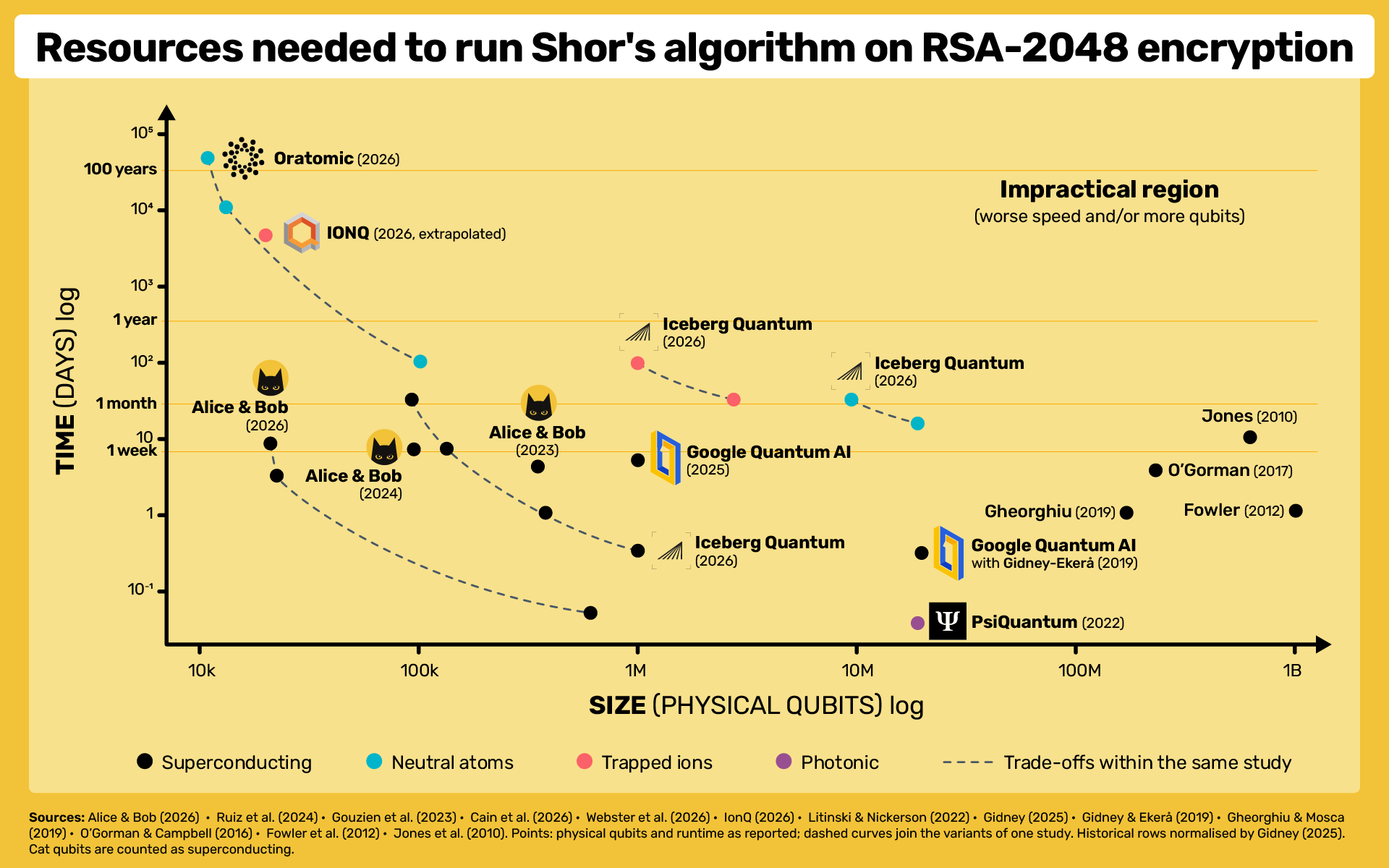
Breaking RSA-2048 with 23,000 cat qubits. 🐈 In 3.14 days
This is the finding of our new paper, the latest resource estimate for Shor’s algorithm, the benchmark the whole field uses to compare quantum hardware 📄
The results are a record low for total quantum resources at this… Show more
This is an impressive claim, one that suggests that there have been dramatic improvements with their technology.
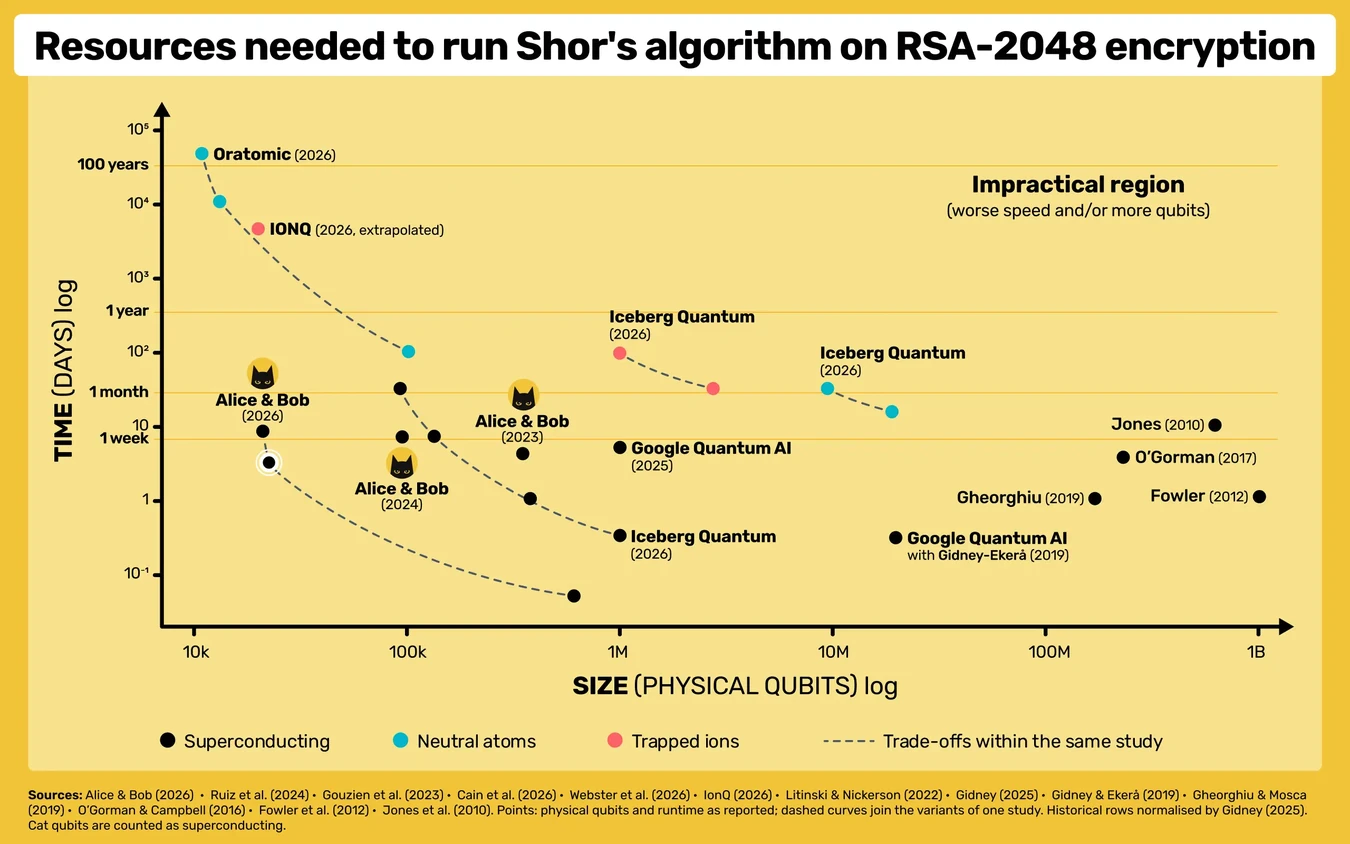
In the chart published on October 29 they included some questionable details:
- Including IonQ in a chart about RSA-2048 requires an extrapolation from IonQ’s paper about elliptic-curve methods. The conversion is done by Alice & Bob, with no method given.
- The chart initially included a PsiQuantum estimate (19 million qubits, 54 minutes). The estimate is for a conventional matter-based machine. PsiQuantum’s photonic version is not counted in qubits and Alice & Bob presented it as the fastest reference on the chart. By November 4th Alice & Bob removed the PsiQuantum references from the chart, and Photonic from its legend. Maybe they realized this was a mistake.
These are minor issues, but one wonders if a culture of imprecision pervades.
Acclaimed quantum computing researcher Craig Gidney responded:
 Craig Gidney@CraigGidney
On the cat qubit factoring paper: as with most of Élie's estimates, it comes down to whether you buy the insane upfront assumption. This time the assumption is LITERALLY ZERO bit flip errors. The algorithmic work looks good, the conclusion follows, but brother what a premise.
The company’s blog post states that their approach works if they get to 0 bit flips. Their researchers write that this “requires a bit-flip time of about 100 years. We are not there yet…” Alice & Bob’s best peer-reviewed bit-flip time is 22 seconds. If bit flips occurred at a rate of about once per hour and they were to provide 45,000 physical qubits this could be achievable. They recently sold an 18-qubit system, but a 12-qubit chip is the largest they have reported results on. By 2030 they claim that they can deliver 100 logical qubits using 2,000 physical qubits.
The company’s history of claims is limited and poor.
- In 2020, the company said that they had “plans to offer its first universal machine in just 5 years.” By 2024, they moved that date to 2030.
- In 2022, CEO Théau Peronnin said “this is our core goal to deliver on the cloud our first logical qubit next year.”
- In October 2023, they extended the goal, saying it “could be available as soon as the first quarter of 2024.” There’s no record of this occurring; it looks like they missed it.
- By October 2026, they stated that distance-3 code was “achieving a logical error rate not yet below threshold.”
“Under-promise and over-deliver” is a tried and true approach. It might be time for Alice & Bob to revisit this maxim.