Quantum Performance Is Improving Faster Than You Think
We humans have many cognitive biases that impact our ability to make accurate predictions. One of these is the Exponential Growth Bias (EGB).[1] We tend to linearize nonlinear processes and underestimate the compounding features of exponential functions. When new technologies come to market, for example, we may have an understanding of how the product works and performs, but we often fail to accurately predict future performance and cost. It’s as if we take its current state and apply a linear function to its ongoing improvement. But, we fail to consider how change is a function of improvements across a set of components and manufacturing processes. And, how economies of scale can translate into dramatic improvements in performance and price. Exponential change is everywhere in nature. One only needs to watch a seed turn into a tree to witness exponential changes in scale. With a little effort and patience one can see it unfold in industry.
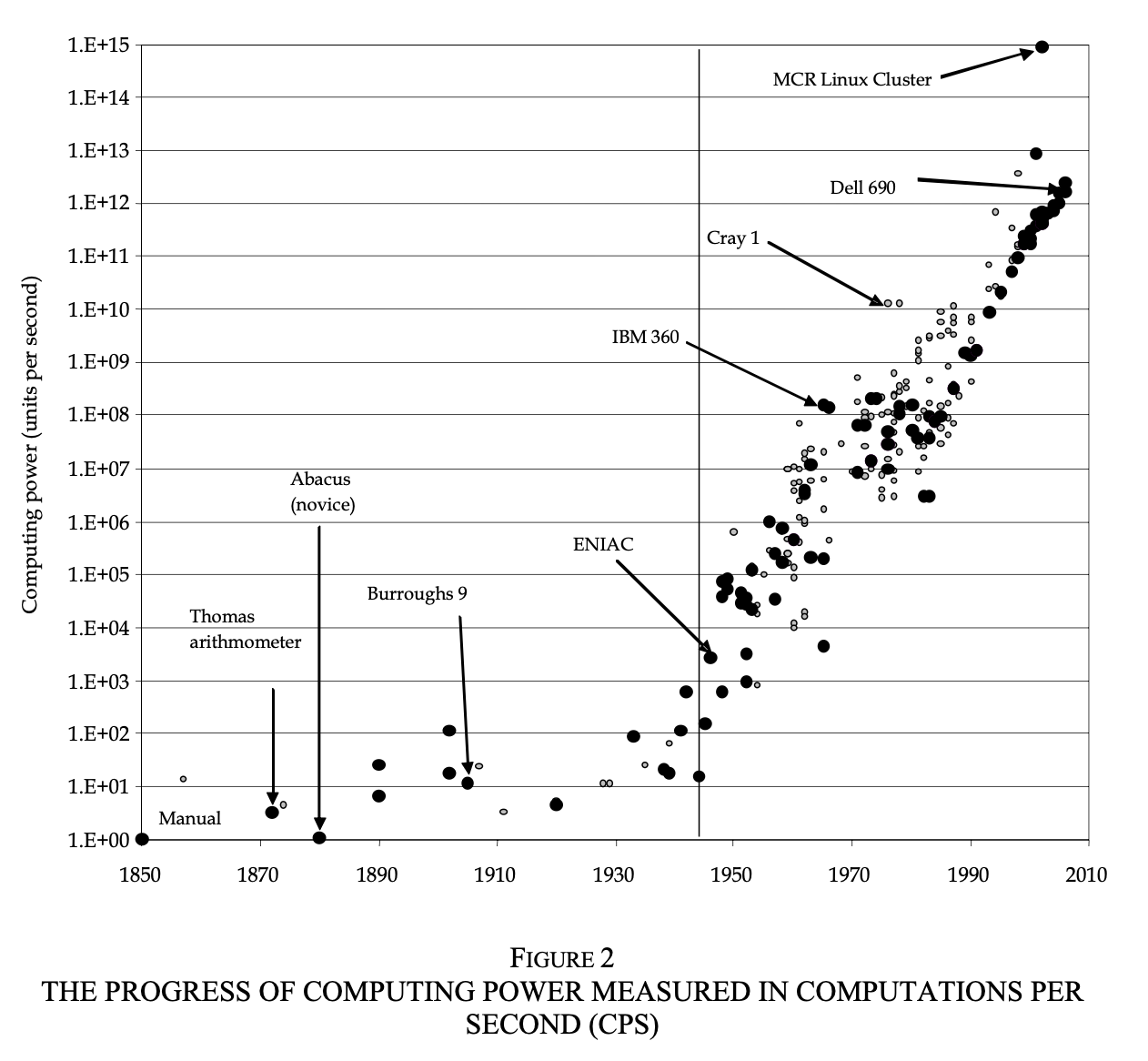
The semiconductor industry has been active for nearly 75 years. Computing has been around much longer, however. If we look at this chart from William Nordhaus, we see that he measures compute performance from the mid-19th century to the early 2000s. Over the period we see a one-quadrillion-fold performance improvement.[2] These exponential leaps in performance and efficiency exist in other industries too.
Lightbulb manufacturing and design, for example, was done by hand in the 1880s, producing about 165 lightbulbs per day. By the 1980s, the automated process achieved a 17,455-fold improvement, producing 2.88 million bulbs per day. Light would go from being a luxury to a common feature of society.[3]
Penicillin production from 1945 to 1980 increased 2,400-fold, with prices decreasing by a factor of 1,000. The impact during World War II and in the subsequent decades was significant in terms of lives improved and saved.[4]
The first human genome to be sequenced was an ambitious scientific and technological project. It started in 1990, took thirteen years, and cost approximately $2.7B for a single human genome. By 2007, the cost was in the millions of dollars per genome and took weeks. By 2014, the cost was $1,000 and could be done in a day. Today, the cost is in the hundreds of dollars and takes hours. The efficiency gain from $2.7B to $400 is 6,750,000-fold. A giant improvement. Going from thirteen years to four hours, we see a gain of 28,470x. While Moore’s Law drove down the cost of compute, most of the gains were achieved through processing improvements and chemistry. I think it’s important to keep in mind here that sequencing was done manually, but was limited to hundreds of base pairs. If scientists had attempted to sequence the entire genome manually it would have taken ~40,000 years of manual effort. The true efficiency gain, then, is 87,600,000-fold from manual mapping to today’s computer mapping.[5]
A technology or product that is exotic one decade becomes common and familiar in subsequent decades. It goes from extremely expensive to affordable, from being alien to being a necessity. Quantum computers are on a similar trend.
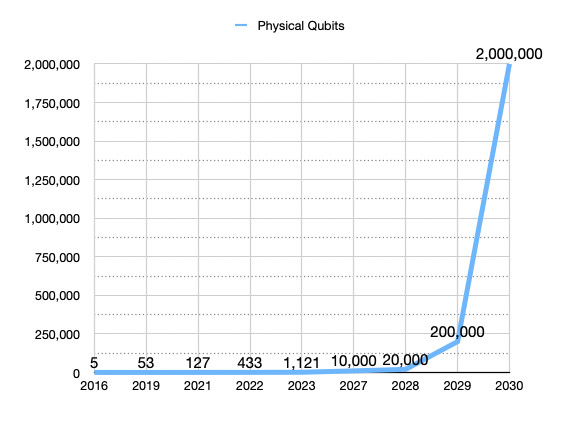
In 2016, IBM built one of the first quantum computers with 5 qubits. In 2019, Google built one with fifty-three qubits. By 2023, IBM’s machine reached 1,121 qubits. IonQ has the most aggressive roadmap — by 2030 they target 2,000,000 physical qubits. If their 2030 milestone is achieved that would be a 400,000-fold increase in 14 years.
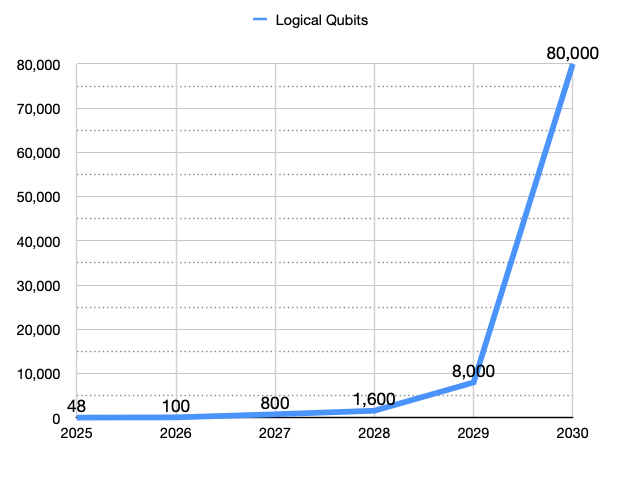
Now, these are machines with physical qubits and everyone knows that logical qubits are a better measure of performance (not a perfect one!). Logical qubit counts follow a similar curve. In 2025, Quantinuum offered a 48 logical qubit machine. In 2026, QuEra achieved 96 logical qubits from 448 physical atoms.[6] If we refer to IonQ’s roadmap we see 800 logical qubits in 2027, 1,600 in 2028, 8,000 in 2029, and 80,000 in 2030. That would be a 1,667-fold improvement in five years.
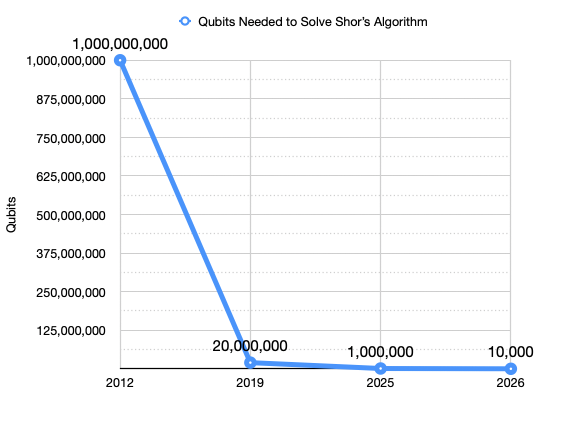
To get to this kind of performance the industry is relying on a mix of hardware and software improvements. Error correction is a key source of performance improvements. Looking at the resources required to run Shor’s algorithm from 2012 to today we see an incredible 100,000x reduction in the estimated number of qubits required, from 1 billion in 2012 to 10,000 in 2026.[7]
Quantum computers were largely theoretical 15 years ago. They were then exotic machines available to only a few researchers. Today, there are hundreds of quantum computers available to researchers and to the general public via cloud computing providers. We are at the end of the NISQ era, beginning the Fault-Tolerant Quantum Computing (FTQC) era, a path toward optimal performance has been unlocked, and, as you can see, the efficiency gains achieved within a decade are impressive. If milestones on company roadmaps are achieved, the additional gains will be astounding.
Quantum computers are unlike classical computers, especially when it comes to the computational space they provide. Classical computers offer linear or single-exponential improvements across generations of processors. With quantum, each additional logical qubit doubles the available computational space. If the number of usable qubits also grows exponentially, across QPU generations, these two effects combine to produce a double-exponential expansion of compute space (sometimes referred to as Neven’s Law)[8]. Now, if you’re like me, you might read that sentence and draw a blank, and wonder: what does double-exponential mean?
A simple way to describe this is to define classical as having n values and quantum as having 2ⁿ values.
| Bits / Qubits | Classical states | Quantum states |
|---|---|---|
| 2 | 2 | 4 |
| 3 | 3 | 8 |
| 4 | 4 | 16 |
| 5 | 5 | 32 |
| … | … | … |
| 20 | 20 | 1,048,576 |
| … | … | … |
| 1,000 | 1,000 | 10,715,086,071,862,673,209,484,250,490,600,018,105,614,048,117,055,336,074,437,503,883,703,510,511,249,361,224,931,983,788,156,958,581,275,946,729,175,531,468,251,871,452,856,923,140,435,984,577,574,698,574,803,934,567,774,824,230,985,421,074,605,062,371,141,877,954,182,153,046,474,983,581,941,267,398,767,559,165,543,946,077,062,914,571,196,477,686,542,167,660,429,831,652,624,386,837,205,668,069,376 |
You can see how quantum’s computational space grows exponentially. Now, if we doubled the growth of qubits in each new generation (growing 2, 4, 8, 16, 32 and so on) we would see the double-exponential acceleration that people talk about. “Double” is doing some special work here. It assumes that each new generation of computer has twice as many logical qubits, which is not a law, but it is a trait we do see in the current era of hardware.
Even if we remove the double factor and just look at a quantum computer with 100 logical qubits (2¹⁰⁰) and compare that with IonQ’s 2030 milestone of 80,000 logical qubits (2⁸⁰⁰⁰⁰) we can see that the increase in computational space is… impossible to fathom. It is a number 24,000 digits long. Not just 24,000 times more.
The caveats here are worth mentioning. Algorithms do a lot of heavy lifting to produce meaningful results in this paradigm. There’s no free lunch; many qubits are needed to support the algorithm, such that actual logical qubits used for computation are less than 80,000. Not surprisingly, some believe that such an achievement is far-fetched.
The most extreme skepticism comes from Palmer’s Law, which claims that a quantum computer can never entangle more than 1,000 qubits.[9] In recent years, problems that only quantum computers could solve have been cracked by novel classical methods, some using AI. Quantum advantage is achieved one year, only to be negated the next. Others have identified limitations in superconducting systems — expensive refrigeration and poor connectivity — making large-scale fault-tolerant quantum computing a remote possibility. Some have noted that scaling will require quantum memory (QRAM) and quantum networking which are still early in their development. Of course, it turns out that quantum networking is improving along similar curves.[10]
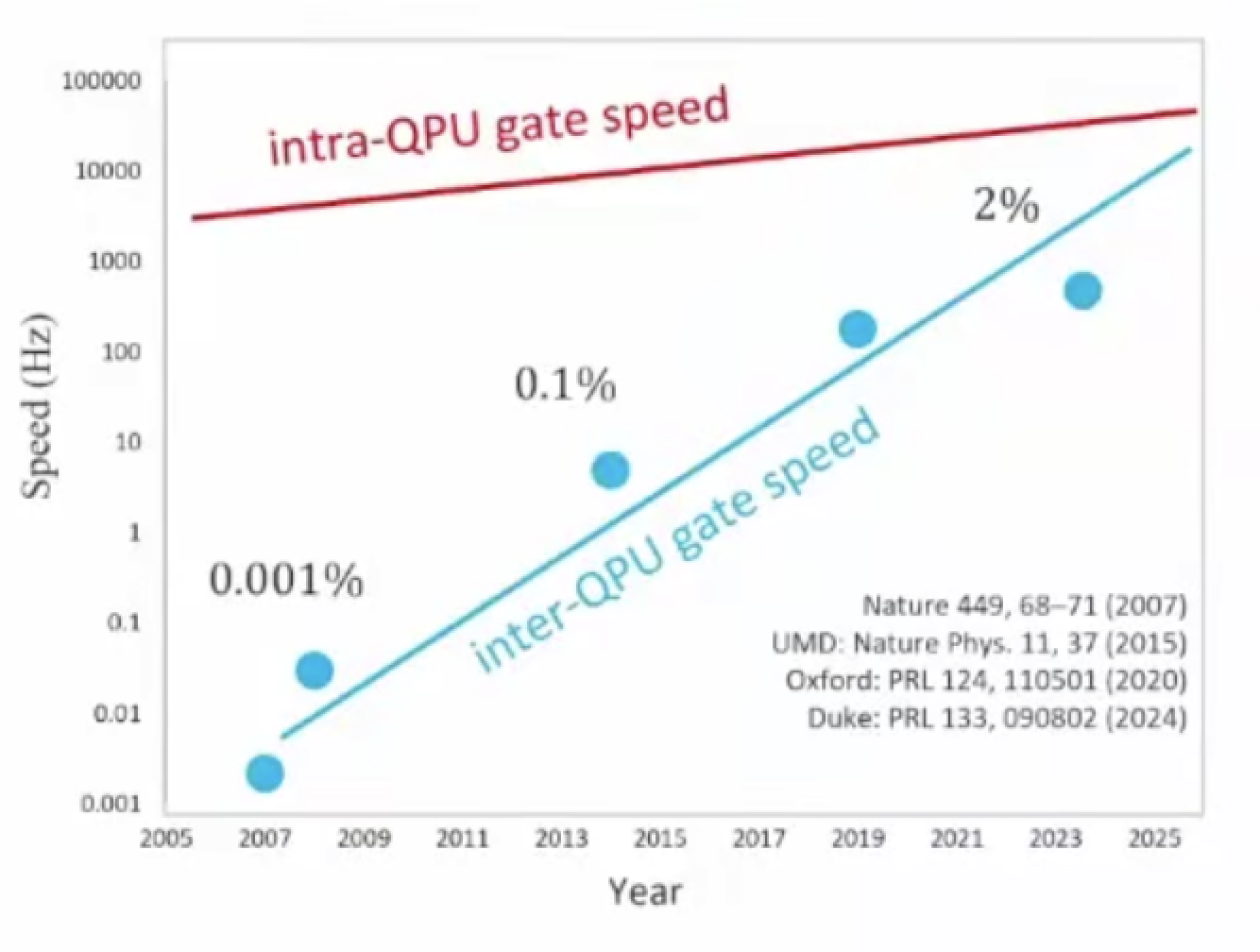
In the above chart, we see that in 2007 there was an inter-QPU gate speed of approximately 0.00196Hz. By 2024, researchers had achieved a speed of 250Hz. That is a 127,500-fold improvement. The blue trend line suggests that researchers will match or nearly match intra-QPU speeds in the next few years.
Quantum’s progress is driven, in part, by academic research. But, performance and efficiency gains in products are driven by industry and commerce. Chris Monroe is a co-founder and currently the Chief Scientist at IonQ. During the company’s early days he was the CEO. He tells a story about a time when he pushed back against making a system available on the cloud for commercial purposes. There was so much to solve, so many headaches to resolve, that he didn’t think it was possible. The board disagreed and essentially forced the team to do it. To Monroe’s surprise they delivered a commercial system (57:19). Often industry has the motivation and the drive to take scientific and technological discoveries and transform them into solutions for customers. Then, through running a loop of continuous improvement, the product becomes more and more efficient. As the business produces more and more, economies of scale emerge, making the product perform better at lower and lower prices.
Today, we sit at the end of the NISQ era. This era’s primary effort has been building quantum computers in order to learn how to make them scalable and fault-tolerant. In about five years’ time we will have the first scaled fault-tolerant quantum computers (FTQC) that will begin to transform industry. By the mid to late 2030s, these systems will be transforming and improving society, providing social and economic benefits to humanity. Looking back over the last century of progress we see how the lightbulb brought light to the world, penicillin reduced disease and increased our lifespan, and semiconductors transformed nearly every industry and human interaction. When looking forward to the next century of progress we’d be wise to accept exponential change as natural and see how quantum computers will carry human society forward.
Gates’ Law, attributed to Bill Gates, says, “We always overestimate the change that will occur in the next two years and underestimate the change that will occur in the next ten.”[11]
The semiconductor industry evolved over a period of thirty years from calculators to GPUs. The quantum industry will move much faster as it benefits from all of the semiconductor industry’s learnings and capabilities. Quantum is already benefitting from AI acceleration.[12] This new form of powerful compute will unlock scientific and technological discoveries and drive innovation throughout the next one hundred years.
Matthew R. Levy, Joshua Tasoff “Exponential-growth bias and overconfidence”, Journal of Economic Psychology, 2017.
William Nordhaus, “Two Centuries of Productivity Growth in Computing”, Journal of Economic History, 2007.
Brian Potter, The Origins of Efficiency, p. 34. The production figures come from his “What Is a Production Process?”.
Brian Potter, The Origins of Efficiency, p. 12.
Human Genome Project duration and cost from the NHGRI fact sheet; modern sequencing cost and turnaround from MIT Biology. The 40,000-year manual estimate assumes a few hundred base pairs per day across roughly 3.1 billion pairs.
“A fault-tolerant neutral-atom architecture for universal quantum computation”, Nature, January 2026.
Note: these are theoretical estimates of what the proposed error correction methods could achieve.
“A New Law to Describe Quantum Computing’s Rise?”, Quanta Magazine, June 18, 2019.
Tim Palmer, “Rational quantum mechanics: Testing quantum theory with quantum computers”, PNAS, 16 March 2026. To his credit, Palmer says plainly that the next few years of scaling will settle it. I’ll take that bet.
Christopher Monroe, “Quantum Networks with Atomic Memories”, 35:24.
The observation originates with Roy Amara — we overestimate a technology’s effect in the short run and underestimate it in the long run. Gates offered his own version in The Road Ahead (1995).
I’ve written about this a few times. “Two Years Remaining?” is the most direct — IonQ and Oratomic researchers are both on record that AI has been an accelerant for their error-correction work. See also “Microsoft is Accelerating Their Q-Day Readiness Timeline” and “The Other Q-Day”.